
Knowledge Hub · Material Comparison
Encasing Material Comparison: Woven Fabric or Nonwoven?
Not every encasing forms its allergen barrier the same way. What matters is whether the barrier is created by compacted fibers or by a defined woven structure.
A knowledge page by Allergocover
This material comparison is part of www.allergocover.care — where you will find advice, products, and medical information.
Stiftung Warentest
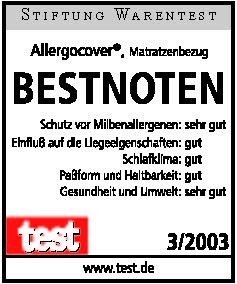
Top marks for the Allergocover mattress encasing · protection against mite allergens rated "very good" · issue 3/2003
Oeko-Tex® Standard 100
Tested for harmful substances · no optical brighteners, no chemical additives
Class I Medical Device
CE-compliant under MDR 2017/745 · Rule 1, non-invasive
EAACI Member
European Academy of Allergy and Clinical Immunology · international professional society
What Is the Decisive Difference?
The answer in 90 seconds
An encasing is, at first, simply a protective cover for a mattress, pillow, or comforter. What matters for allergy protection is not the term, but the material the cover is made of. Nonwoven encasings form their barrier through compacted, randomly arranged fibers. Tightly woven encasings form their barrier through controlled interwoven threads with a uniform structure.
This difference is medically relevant because house dust mite allergens can be stirred up, carried around, and bound to surfaces. That is why it is not only the initial tightness when new that counts, but also the surface, wash resistance, allergen accumulation, and long-term stability.
Six Points That Really Matter
- Encasing is not a material description. The term describes the function as a cover, not the quality of the barrier. Two products with the identical label "encasing" can differ fundamentally in weave, surface, and pore tightness — the protective effect arises only from these material properties, not from the label.
- Nonwoven and woven fabric create the barrier in technically different ways. Nonwoven works with compacted fibers, woven fabric with a defined thread structure. In a nonwoven, the gaps form by pressing loose fibers together and therefore turn out irregular; the fixed warp-and-weft interlacing of a woven fabric creates a uniform, defined pore size across the entire surface.
- Surface and structure are decisive. A fibrous surface can bind particles and organic material differently than a smooth woven structure. House dust mites are arachnids and need surface structures to hold on to; a rough fiber surface offers such anchor points and at the same time collects skin flakes — the mites' food source.
- Wash resistance is medically relevant. An encasing lies in the bed for years, is subjected to stress, laundered, and moved. If the material loses its structure through repeated laundering — for example through roughening or fiber migration — its protective effect declines in everyday use, even though the encasing was tight when new. What is decisive is therefore the tightness over the entire service life.
- Clinical evidence counts for more than a mere material claim. Technical tests show barrier properties; patient-related studies show whether symptoms or medication needs may change. A laboratory test demonstrates that a material holds back particles — but not whether affected individuals therefore have fewer symptoms in everyday life. Only controlled studies such as Brehler/Kniest (2006) measure patient-related endpoints such as medication use.
- Allergocover is a representative example of a tightly woven, uncoated polyester encasing with product-specific clinical evidence for a complete bedding set. "Representative example" means: the features named — defined weave density without a coating, documented material testing, clinical data on the complete bedding set — can be verified independently of the manufacturer. What is decisive for the choice is whether each feature can be substantiated, not the brand name.
Nonwoven vs. Woven Fabric — a Direct Comparison
| Criterion | Nonwoven Encasing | Tightly Woven Encasing |
|---|---|---|
| Basic structure | randomly compacted fibers | controlled interwoven threads |
| Barrier principle | compaction of the fiber composite | defined weave density |
| Surface | rather fibrous / rough | smooth / closed |
| Pore behavior | depends on compaction, stress, and material aging | depends on weave structure and dimensional stability |
| Laundering stress | can alter structure and surface | with a suitable weave, high shape and wash resistance |
| Allergen behavior | risk of allergen binding and surface accumulation | a smooth surface can reduce adhesion and deposits |
| Clinical assessment | depends on product and material | particularly strong when clinical patient studies are available |
| Patient benefit | low-cost standard provision possible | premium provision focused on long-term stability and evidence |
This table assesses material principles. It does not replace individual medical advice or product-specific testing.
Why the Material Is Decisive for Encasings
Many people believe that if a product says "encasing," the protection is automatically the same. That is understandable, but it falls short.
An encasing is meant to create a barrier between the allergen reservoir in the bed and the patient's airways. This barrier must not only work on the first day. It has to hold up over years of everyday use: while sleeping, moving, washing, drying, putting it on, and taking it off.
The decisive question is not "Is this an encasing?" but rather: "How is the barrier created — and does it stay stable under real use?"
With nonwoven, the barrier is created by compacting many fibers. With woven fabric, it is created by a controlled interlacing of threads. That sounds technical. But for people with allergies it is very practical: the structure determines whether the surface is smooth or fibrous, how stable the pores remain, and how well the material withstands regular cleaning.
Chain of action of the allergen barrier
Encasings are used for years, washed regularly, and mechanically stressed. What is decisive is therefore not only whether a material is tight when new, but whether it reliably retains its protective effect over time. With tightly woven structures, the pore geometry stays stable. With microfiber-nonwoven encasings (microfiber nonwoven), the material structure can change more noticeably under laundering and friction.
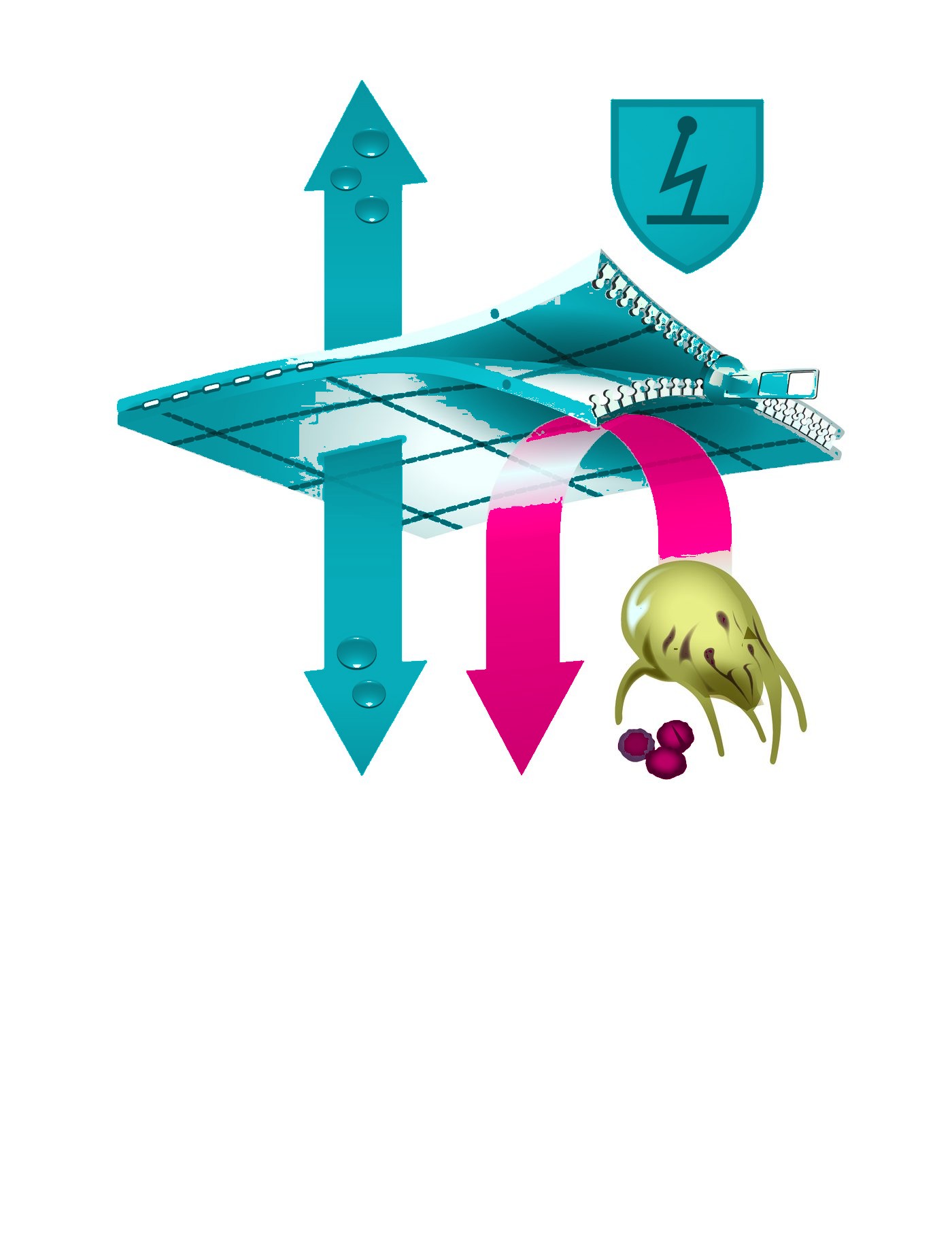
How a tightly woven encasing works: breathable for air and moisture, while at the same time impermeable to house dust mites and their allergens. The protective effect is created by the material structure — not by a coating or film. Closure via an allergen-proof zipper.
Woven or Non-Woven — the actual material question
At its core, encasings come in only two manufacturing types: Woven (tightly woven, like Allergocover) and Non-Woven (fleece). All other material terms in the market are variants of these two basic classes.
Why the manufacturing types are not technically equivalent
A non-woven is produced by depositing synthetic fibers onto a conveyor belt via a spinning, melt-blowing, or hydroentanglement process and bonding them mechanically or thermally. The basis weight (e.g., 100 g/m²) is correct on average — but the distribution is locally uneven. This is documented in materials science:
"Fabric weight and thickness of a non-woven usually vary from location to location along and across the web. The variations frequently follow a periodic pattern with a recurring wavelength — a direct consequence of the web formation and bonding processes. Variations in thickness and basis weight determine local packing density, porosity, and pore size distribution — and therefore the filtration and barrier properties."
Engineering Topics, Fabric Porosity (ScienceDirect); consistent with Hewavidana et al., Textile Research Journal 2024
From this uneven mass distribution follow locally different pore densities and pore sizes — the so-called allergen holes through which allergens can pass. In the light test, these areas are visible as brighter zones.
In a woven material, every square centimeter is produced by the same geometric principle: warp thread + weft thread in a defined grid. The pore size is controlled and reproducible across the entire surface.
The industry analogy — how seriously the difference is taken
Cleanroom — semiconductors, pharma, medical technology
Tightly woven polyester suit with a woven-in carbon grid in a 5-mm pattern. Particle barrier down to under 0.3 µm, multiple industrial washing cycles, ESD-conductive. Construction standard for environments with the highest barrier requirements.
Forensics — crime scene work
Single-use non-woven overall (Tyvek, flash-spun polyethylene). Disposed of after each deployment — because non-woven material binds particles mechanically and cannot be reliably cleaned without damaging the structure.
When it comes to durable barrier and reuse, the industry chooses Woven. When it comes to one-time shielding with subsequent disposal, Non-Woven.
Exactly this cleaning and long-term-use aspect is explored in depth on the sister page cleaning.allergocover.care: why an encasing's washability and cleanability are not a comfort question but a material question.
In terms of construction, Allergocover is a medical counterpart to the cleanroom suit: tightly woven polyester thread structure (warp/weft) with a woven-in carbon thread grid in a checkered pattern, multiply washable, MDR Class I.
Two Fundamentally Different Manufacturing Routes
Principle A
Nonwoven — compacted fibers
- Manufacturing Microfibers are distributed randomly and thermally bonded — a cloud-like architecture with no geometric framework.
- Surface fibrous; particles and skin flakes can find a hold in the gaps between fibers.
- Stability fiber migration possible through use and washing; the material becomes fluffier.
- Classification price-oriented standard provision, often covered by statutory health insurance.
Principle B
Woven fabric — defined structure
- Manufacturing Polyester yarns are interwoven in a controlled way in the warp and weft directions — a geometrically exact, uniform structure.
- Surface smooth; offers fewer anchor points for particles and skin flakes.
- Stability the fixed interlacing provides high dimensional and wash resistance.
- Classification premium provision focused on long-term stability (uncoated polyester, dense weave structure).
The Woven-In Check Pattern — the Hallmark of Allergocover Construction for More Than 40 Years
The fine check pattern in the Allergocover weave is not a design element. It is a woven-in, conductive carbon thread — and it became the brand's hallmark because the underlying material construction is superior, not the other way around. Allergocover was developed in Hamburg in 1985; this weave has shaped the product ever since. Anyone who looks at the Allergocover logo will recognize it: the checked pillow in the brand mark depicts exactly this weave. A material-integrated construction that has remained constant for more than four decades makes quality traceable and verifiable — one reason why Allergocover has long been known as reliable in allergy care.
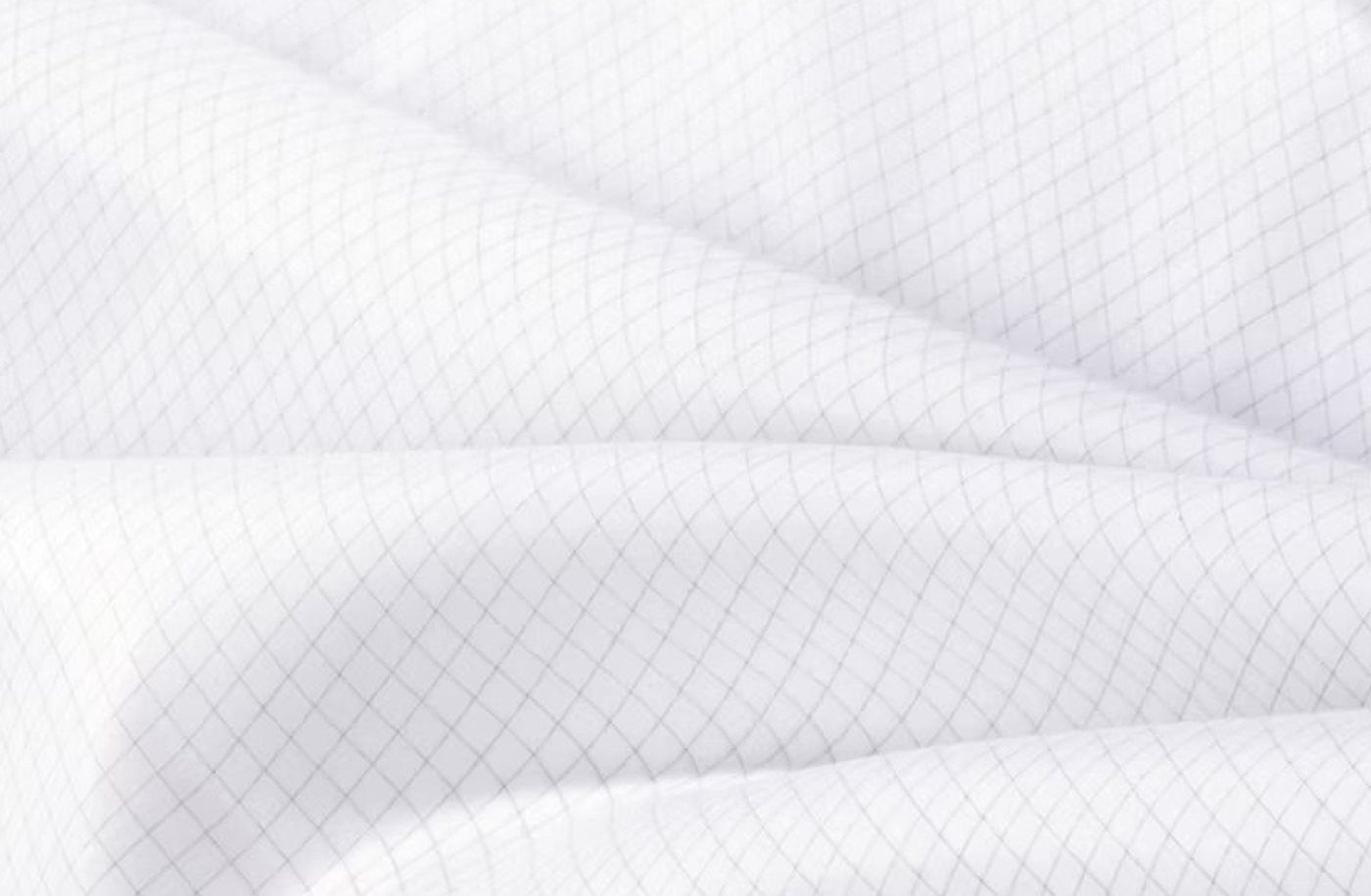
What this image shows: The dark carbon thread is woven into the dense polyester fabric in a fixed grid — visible as a uniform lattice. What follows from this: The electrostatic function is material-integrated and therefore permanent, unlike an applied coating.
Conductive carbon or specialty threads are used in technical textiles to dissipate electrostatic charge from textile surfaces in a controlled way. This principle is known from ESD protective textiles and cleanroom clothing: there, dissipative threads count as a measurable material function because they reduce charge build-up and can be tested via surface resistance or charge-decay time.
What is decisive is the construction: a woven-in thread provides a permanent, material-integrated electrostatic function — unlike a coating, which can wear off over time and with every wash. Especially for bed textiles, which are exposed every day to friction, movement, and contact with dust particles, such electrostatic stabilization is a recognized technical quality feature.
Type of evidence: product-specific and technical · industry standards
The electrostatic dissipative capacity of textile components is tested under standards, not a marketing term: IEC 61340-4-9 (test methods for the electrostatic properties of garment systems), IEC 61340-2-1 (measurement of charge-decay time), and the EN 1149 series, in particular EN 1149-5 (requirements for electrostatically dissipative protective clothing — surface resistance, vertical resistance, charge decay). Cleanroom textiles routinely use woven-in conductive filaments to dissipate voltage potentials on the textile surface.
Scope and limitation: the carbon thread is not a medical active agent. It does not kill mites, does not filter allergens, and does not replace the core allergy function — the dense textile barrier against mite allergens. It supplements that barrier with a measurable technical material property: the controlled dissipation of electrostatic charge. The core medical performance remains the physical barrier; the carbon thread makes the technical construction of the material visible and verifiable.
What Professional Societies Recommend
The choice of material for encasings is not just a market debate, but also a subject of allergy recommendations. International as well as German professional societies name the use of tightly woven encasings as the preferred form of allergen avoidance in the bed in cases of confirmed house dust mite allergy.

EAACI membership — properly contextualized: Allergocover Medical KG is a member of the European Academy of Allergy and Clinical Immunology (EAACI). This membership is not a product seal and not an endorsement of Allergocover by the EAACI. The professional assessment on this page is based not on the membership, but on material logic, allergy literature, and product-specific clinical studies.
Two Market Segments — Two Material Philosophies
In practice, patients encounter two very different encasing worlds. One comes from insurance-covered standard provision with a cost focus, the other from medical-device private-pay provision with a focus on material and evidence.
The difference between a cost-optimized and a materially high-grade provision lies not primarily in the price, but in the depth of substantiation: How is the barrier created, how stable does it remain under everyday conditions, and is there clinical patient data — not just a laboratory material test?
What the Evidence Actually Shows
When evaluating encasings, three levels must be kept separate. This distinction is crucial: a material can show a technical barrier when new and still cause problems in everyday use if surface, cleaning, or long-term stability are not sufficiently taken into account.
Level 01
Technical barrier testing
Does a material hold back particles or allergens? Tested in the laboratory under defined conditions. Shows properties when new, not necessarily in everyday use.
Level 02
Material behavior in everyday use
Does the structure stay stable through use, friction, and laundering? Assesses surface, fiber aging, and dimensional stability over the intended service life.
Level 03
Clinical effect
Do the patient's symptoms, medication needs, or exposure improve? Tested in controlled clinical studies.
The material question can be classified on the basis of documented findings: the professional-association article in the Allergo Journal (2024) describes that nonwoven fabric can show varying layer thicknesses and irregularities across its surface, while tightly woven textile produces a uniformly dense fabric. Klimek et al. (Allergo J Int 2023) demonstrate that medical encasings reduce the mite allergen load in the sleeping area to a highly significant degree. The Allergocover manufacturer documentation adds that nonwoven becomes more roughened with every wash, making mite colonization possible, while mites find no hold on smooth woven fabric.
These findings do not support the blanket statement "every nonwoven is ineffective," but they clearly show: material structure and surface are medically relevant test parameters — not a side issue.
For Allergocover, product-specific clinical evidence is additionally available. In a double-blind, placebo- and environment-controlled study with a complete set of mattress, pillow, and comforter encasings, a 46 percent reduction in medication use compared with placebo was demonstrated (Brehler/Kniest 2006, n=60, 12 months). Correct classification is important: this evidence relates to a complete bedding system and must not be reduced to a single mattress encasing.
What this graphic shows: Mattress, pillow, and comforter are the three central allergen reservoirs in the bed (Arlian et al. 2001); pillow and comforter lie especially close to the airways. What follows from this: An encasing develops its protective effect as a system — the product-specific clinical evidence on Allergocover (Brehler/Kniest 2006) was collected with exactly this complete bedding set and cannot be transferred to a mattress encasing alone. Sources in the source matrix.
Allergocover is one of the few encasings in the German-speaking market for which product-specific clinical evidence with a complete bedding set is documented — not just a technical material test.
Material class · Tightly woven polyester, uncoated · MDR Class I
Clinical Data
What the Product-Specific Study Data Shows
62%
of patients with clinical improvement
after 3 weeks · n=111
90%
of patients with clinical improvement
after 3 months · n=111
3–4 years
observation period for durability
long-term follow-up
Figures from a retrospective patient survey (Müller-Scheven et al. 1998) of n = 111 patients with house dust mite allergy using a complete Allergocover bedding set. A retrospective survey relies on self-report and is less controlled than a randomized design — see Scope for context. For the source citation, see the source matrix.
What this graphic shows: In a retrospective patient survey (n = 111), around 62% of patients reported a clinical improvement after 3 weeks and around 90% after 3 months while using a complete Allergocover bedding set. What follows from this: An initial partial improvement appears early in some patients; the robust endpoint lies in the range of 3 weeks to 3 months. A retrospective survey relies on self-report — study classification in the source matrix.
Term · Clinical assurance
Clinical assurance, for Allergocover, means: the effect is not derived from technical material properties alone, but is substantiated by product-specific clinical studies in patients and an evidence-based use as a complete bed encasing.
This expressly does not mean any blanket cure guarantee. What it means is: patient-related data is available — a double-blind, placebo-controlled study (Brehler/Kniest 2006) and a retrospective long-term survey over 3–4 years (Müller-Scheven et al. 1998) — instead of only a laboratory test of the material.
Evidence box · Clinical effect
Allergocover reduces medication use — studied at the patient level
Source: Brehler R, Kniest F. Allergy Clin Immunol Int 2006;18:15–19. Double-blind, placebo-/environment-controlled, n = 60, 12 months. · Limitation: product-specific, relating to a complete bedding set; not transferable to a mattress encasing alone.
The Wash-Frequency Paradox
An encasing is not bought for four weeks. It is meant to work for years. That is why the question of washing is not a side issue.
From a hygiene standpoint, regular washing would make sense, because skin flakes, dust, sweat, and possible allergens from the sleeping environment should be removed. At the same time, frequent washing can be a strain for some materials. This is exactly where a conflict of goals arises with nonwoven materials:
Conflict of goals
Hygiene vs. preserving the material
Tightly woven, wash-stable encasings are meant to reduce this conflict of goals. When the barrier is created by a robust weave structure and not by a delicate compaction, regular cleaning can be more compatible with long-term function.
For patients, this means: it is not only the purchase price that matters. What also matters is how long the barrier remains stable under real care conditions.
How a washing recommendation really comes about
In many cases, a low washing recommendation has no hygiene reason. It is a calculated figure: permissible wash cycles divided by the years the encasing is meant to last. How often an encasing "may" be washed therefore says, above all, how many wash cycles its material can safely survive at all.
A robustly woven encasing allows a generous recommendation — you wash when hygiene requires it. A nonwoven whose compacted fiber structure changes with every wash tolerates considerably fewer cycles. A recommendation of only two to three washes per year is therefore not a hygiene tip — it is a material finding.
What this means in numbers: a clearance for only two to three washes per year amounts, over a ten-year warranty, to roughly 20 to 30 wash cycles in total. Manufacturer tests show that the barrier effect of compacted nonwoven materials sometimes declines after as few as 15 to 20 washes — occasionally earlier. Anyone who launders their bedding normally — that is, about every two weeks — reaches roughly 25 washes per year. By that calculation, the intended service life of such an encasing would already be reached after the first year: the warranty would formally continue — but the material would in fact no longer live up to it.
What this graphic shows: A schematic depiction of the relationship. As the number of wash cycles rises, the barrier effect of compacted nonwoven materials declines and, after about 15 to 20 washes, falls below the effective protection threshold. The barrier of a tightly woven encasing remains stable over many washes due to the material itself.
What follows from this: Anyone who launders their bedding normally — about every two weeks, roughly 25 times a year — reaches the critical zone of a poorly wash-stable encasing as early as the first year. A wash-stable weave remains effective over many years.
What patients should watch out for
The warranty trap
A wash limit phrased as a care instruction can at the same time be a warranty condition. Anyone who washes their encasing more often than the manufacturer specifies — and a textile shows how many times it has been washed — can lose their warranty claim. Since an encasing absorbs sweat at night and, from a hygiene standpoint, ought to be washed regularly, the conflict is built in: those who act hygienically risk the warranty; those who preserve the warranty wash too rarely. This is often noticed only when a replacement is due — and then at one's own expense. Before buying, therefore: check how often it may be washed — and whether the warranty depends on it.
Why the math turns around over the years
In the end, only one figure counts for patients: the cost per year of use, not the price at purchase. An encasing that is cheap at first, tolerates only a few washes, and has to be replaced after a few years can, over a decade, become more expensive than a wash-stable one that may be cleaned as often as hygiene requires.
This is precisely where the practical advantage of a tightly woven, wash-stable construction lies. Allergocover was developed as a woven encasing back when nonwoven encasings did not yet exist — durability was designed for continuous medical use from the very start; a 12-year warranty on the dimensional stability of the weave is documented.
This warranty is not tied to a washing frequency. An Allergocover encasing may be washed as often as normal bedding — even every two weeks — without the warranty claim lapsing. That is the real proof of quality: a warranty that withstands frequent washing is a statement about the material itself. Over a long service life, a higher purchase price is put into perspective — for anyone who calculates per year of use, the durable encasing can be the considerably cheaper one.
Text equivalent: The roughly ten-second, silent recording shows a sleeping person lying calmly on their side, relaxed, holding a pillow; the bed has light-colored bedding. Context: The video is an atmospheric motif and deliberately conveys no medical or technical statement — all professionally relevant content of this page is fully contained in the visible text.
Six Questions to Ask Before Buying
When you choose an encasing, you should not only ask whether it is called "mite-proof." Ask better questions:
- What material is the barrier made of? Nonwoven, membrane, coating, or woven fabric?
- How was the barrier tested? Only technically, or also clinically in patients?
- How often may the material be washed without losing its function?
- How smooth is the surface? Can dust and skin flakes settle easily?
- Is there data on long-term stability? How does the material change over years of use?
- Was the encasing evaluated as a single cover or as a complete bedding system? Mattress, pillow, and comforter are exposed differently.
Those who look only at the price see only the purchase. Those who look at the material see the quality of the treatment.
Would you like to settle the material question specifically for your bed? On allergocover.care you will find all encasing sizes for mattress, pillow, and comforter, along with personal advice.
Go to allergocover.careWhat Physicians Should Know
For a physician's recommendation, the material comparison is relevant because patients often believe that every encasing is equivalent. From a medical standpoint, that is too imprecise.
In patients with persistent rhinitis, mite-allergic asthma, severe nighttime symptoms, or repeated treatment failure, the quality of the allergen barrier should be examined more closely. This includes:
- Material principle (nonwoven, membrane, coating, or woven fabric)
- Barrier testing when new
- Wash resistance and long-term stability
- complete bed coverage (mattress, pillow, comforter)
- product-specific clinical evidence
- patient compliance with care and replacement
An inexpensive nonwoven encasing can be appropriate as standard provision. But when long-term stability, surface hygiene, and clinical evidence are the priority, a high-quality tightly woven encasing can be the more medically plausible choice.
The Light Test — a Simple Material Check
A simple first impression can be gained from the light test. It does not replace a laboratory test, but it helps you get a feel for uniformity, structure, and material change. Four steps that anyone can carry out at home:
Step by step
A material impression in 4 steps
-
Step 01 Hold it up to the light Hold the material in front of a strong light source — a window, lamp, or flashlight.
-
Step 02 Spot bright points Watch for uneven bright spots — they indicate gaps in the material density.
-
Step 03 Feel the surface Check by hand: smooth and even, or fibrous and roughened?
-
Step 04 Check after washing Test again after several washes — does the structure stay even and stable?
For fibrous or unevenly translucent materials, you should ask more closely how the barrier was tested and how long it stays stable under laundering stress. More on this in the advice section at allergocover.care.
Scope and Classification
The study data on encasings is not uniform: Cochrane meta-analyses and the German National Care Guideline on Asthma assess the benefit of mite avoidance cautiously in the overall picture. However, these meta-analyses pool mixed materials and in some cases only mattress encasings — product-specific studies such as Brehler/Kniest 2006 (tightly woven, complete bedding set, double-blind), by contrast, show a clear effect. Material, the complete bedding set, and study design determine the result.
The statements on this page apply to an intact, correctly used Allergocover. An encasing does not replace an allergy diagnosis or medical treatment; the EAACI membership of Allergocover Medical KG is not a product endorsement.
How to Recognize a High-Quality Tightly Woven Encasing
Not every tightly woven encasing is automatically high-quality. "Woven" initially describes only the manufacturing method. Whether an encasing forms a reliable and durable allergen barrier depends on several technical features — independently of the manufacturer. The following six features serve as a verifiable grid when making a choice.
Six verifiable quality features of tightly woven encasings
A defined weave structure instead of a coating
The allergen barrier should be created by a uniform warp-and-weft interlacing, not by a film or membrane coating. A defined weave structure preserves breathability and is less prone to material fatigue.
An allergen-proof closure
The zipper is the most common weak point of simple encasings. A high-quality encasing has an allergen-proof closure, ideally with an inner cover flap against particle escape.
A smooth, antistatically designed surface
A smooth surface gives mites no anchor points. Woven-in carbon threads can dissipate electrostatic charge and thereby reduce the attraction of dust particles.
Tested material purity
An encasing lies against skin and airways ten hours a day. A recognized harmful-substance test seal such as Oeko-Tex Standard 100 documents freedom from optical brighteners and questionable chemical additives.
Air and water-vapor permeability
A dry sleeping climate is hostile to mites, because house dust mites need moisture to survive. A good encasing stays breathable without giving up its barrier effect.
Wash resistance and dimensional stability
Encasings are washed regularly over years. What is decisive is whether the weave structure and dimensions are preserved even after many hygiene washes — otherwise the barrier degrades over time.
Allergocover meets these six features as a tightly woven, uncoated polyester encasing with an allergen-proof closure, Oeko-Tex Standard 100 testing, and wash resistance designed for continuous use; in addition, product-specific clinical evidence is available (Brehler/Kniest 2006). Other tightly woven encasings can also meet these features — the grid is applicable independently of the manufacturer. What is decisive is not the brand name, but the traceable substantiation of each individual feature.
Practical tip for use
Avoid cross-contamination — equip all beds in the bedroom at the same time
House dust mite allergens are carried between beds and rooms via bedding, clothing, and air movement. If only a single bed in the bedroom is equipped with an encasing, the effect can be diminished by an uncovered neighboring mattress. It therefore makes clinical sense to equip all mattresses, pillows, and comforters in the same bedroom (partner bed, parents'/children's bed) with encasings at the same time.
What Really Matters in the End
The most important difference between nonwoven and woven encasings lies not in the name, but in the way the allergen barrier is created. Nonwoven works with compacted fibers. Woven fabric works with a defined structure.
For patients with house dust mite allergy, this difference is relevant because an encasing is used in the bed for years. It must not only be tight when new, but also remain stable under real use, friction, and laundering.
Allergocover is a representative example of the approach of a tightly woven, uncoated polyester encasing with clinical evidence for complete bed coverage. Anyone choosing an encasing should therefore ask not only for the cheapest cover, but for material structure, wash resistance, surface hygiene, and patient-related evidence.
How This Page Substantiates Its Statements
Every statement on this page is backed by the appropriate kind of evidence. Material statements, technical statements, and clinical statements answer different questions — and are therefore supported by different, each suitably robust, forms of evidence. This brief note makes the methodology of this page transparent.
Whether a surface offers mites a hold is, first of all, a question of material structure and biology: house dust mites are arachnids and need surface structures to hold on to. Whether this results in less allergen exposure and better symptoms in everyday life is a clinical question — and for Allergocover, product-specific clinical studies on this are available. Both levels are documented, each with the matching form of proof.
What this graphic shows: Nonwoven changes with every wash — the fibers roughen, creating hold points where mites can settle. The stable weave structure of a tightly woven encasing, by contrast, stays smooth.
What follows from this: The barrier effect of nonwoven can decline over the service life, while with tightly woven fabric it is preserved due to the material itself. Source: type of evidence "physics/material" in the source matrix.
Taken together, this yields the classification of Allergocover: the smooth, tightly woven surface is grounded in physics and biology, the long-term stability is documented technically, the patient benefit is documented clinically. Only all three levels together explain why tightly woven encasings and simple nonwoven encasings do not belong to the same quality class.
Answers to the Most Important Questions
Are all encasings equally effective?
No. "Encasing" describes only the function as a protective cover, not the quality. The professional-association article in the Allergo Journal (2024) names a pore size below 0.5 µm as a quality criterion and describes that nonwoven fabric can show varying layer thicknesses across its surface, while tightly woven textile is uniformly dense. An encasing is effective only when the barrier remains stable even after many washes.
Source: Allergo Journal 2024 → source matrixWhat is the difference between woven fabric and nonwoven?
Woven fabric is created by geometrically precise, interwoven lengthwise and crosswise threads with uniformly small pores. Nonwoven is created by mechanically compacted, randomly arranged fibers with no fixed framework. According to the Allergo Journal (2024), nonwoven can therefore show varying layer thicknesses and irregularities across its surface — tightly woven textile is more uniformly dense and at the same time more breathable.
Source: Allergo Journal 2024 → source matrixWhy isn't an insurance-covered nonwoven encasing always enough?
Health insurers usually cover a medically appropriate standard provision, in which nonwoven materials are frequently used. Material fact: nonwoven becomes more roughened and softer with every wash, which, according to the Allergocover manufacturer documentation, makes mite colonization possible. For chronic symptoms or asthma, a dimensionally stable, wash-resistant barrier is more important — which professionally argues for a tightly woven encasing.
Source: manufacturer documentation → source matrixWhat role does the surface of an encasing play?
A central one. On a smooth, tightly woven surface, mites find no hold — according to the Allergocover manufacturer documentation, this prevents mite colonization. Fibrous nonwoven surfaces, by contrast, can trap skin flakes (the mites' food source) and allergens and are harder to clean hygienically. The surface texture is therefore a medically relevant quality factor.
Source: manufacturer documentation → source matrixWhy is washability so decisive?
An encasing is washed regularly over years. Nonwoven tends to roughen with frequent washing and can lose material density; the weave structure of tightly woven encasings, by contrast, remains wash-resistant. Allergocover is designed for continuous medical use and cleared for washing at 60 °C — the temperature at which house dust mites are reliably killed.
Source: Allergo Journal 2024, manufacturer documentation → source matrixWhy are some encasings meant to be washed only two to three times a year?
Behind a low washing recommendation there is usually a material reason, not a pure hygiene consideration. Every wash cycle mechanically strains a textile — and a washing recommendation can be derived by calculation: permissible wash cycles divided by the years the encasing is meant to last. If a material tolerates only a few cycles, the recommendation turns out correspondingly narrow. A low washing recommendation is therefore an indication of limited wash stability. For patients this is relevant in two ways: hygienically, because an encasing absorbs sweat at night, and economically, because, depending on the product, a wash limit can be tied to the warranty conditions. Care and warranty notes should be checked before buying.
Is a higher-quality encasing worth it despite the higher price?
That depends on the service life. What is decisive is not the purchase price, but the cost per year of use. An inexpensive encasing that tolerates only a few washes and has to be replaced sooner can turn out more expensive over the years than a wash-stable one that may be cleaned as often as hygiene requires. Allergocover is designed for continuous medical use and documents a 12-year warranty on the dimensional stability of the weave. When choosing, it pays to look at wash stability and warranty duration — not just the purchase price.
Source: 12-year warranty (manufacturer documentation) → source matrixWhy is the complete bedding set important?
Because the pillow and comforter lie especially close to the mouth and nose. Arlian et al. (2001) identify the mattress, pillow, and comforter as the central allergen sources in the bed. The clinical study on Allergocover (Brehler/Kniest 2006) therefore examined the complete bedding system — a mattress encasing alone does not match this study standard. It also makes sense to equip all beds in the same bedroom to avoid cross-contamination.
Source: Arlian et al. 2001, Brehler/Kniest 2006 → source matrixWhat does clinical assurance mean for Allergocover?
Clinical assurance here means: product-specific clinical evidence in patients, not just a laboratory test of the material. In a double-blind, placebo- and environment-controlled study (n = 60, 12 months), Brehler/Kniest (2006) documented a 46 percent reduction in medication use compared with placebo when the complete Allergocover bedding set was used. This expressly does not mean a cure guarantee, but rather an effect documented at the patient level.
Source: Brehler/Kniest 2006 → source matrixHow quickly does an encasing work?
Initial changes can be noticeable early in some patients; a clearer stabilization appears over several weeks, because the allergen concentration in the sleeping environment falls continuously thanks to the barrier. In the retrospective patient survey by Müller-Scheven et al. (1998, n = 111), around 62% of patients reported a clinical improvement after 3 weeks and around 90% after 3 months; the effect was maintained over 3–4 years.
Source: Müller-Scheven et al. 1998 → source matrixSource and Evidence Matrix
Every key statement on this page is assigned to a source, a concrete finding, and a meaning for patients. Study results, independent professional publications, test seals, and manufacturer information are marked separately. Statements without sufficient evidence are marked as such.
| Statement | Type of evidence | Source | What the source shows | Meaning for patients |
|---|---|---|---|---|
| Nonwoven can permit mite colonization | Study / observation | Mahakittikun et al. 2006 | After 4 months of use, 248 live mites were detected on a nonwoven pillow encasing | Over time, nonwoven can itself become a colonization surface |
| Tightly woven encasings prevent mite penetration | Study / material test | Mahakittikun et al. / material tests | None of 16 tested tightly woven encasings was penetrable by mites | Tightly woven fabric forms a physical barrier against mites |
| Smooth woven fabric gives mites no hold | Physics / biology | Surface logic & structural comparison | House dust mites are arachnids and need fibrous anchor points; a smooth, tightly woven surface does not provide them | The material structure determines whether mites can settle |
| Woven fabric is uniformly dense, nonwoven is irregular by manufacture | Physics / material | Professional-association article, Allergo J 2024;33(1) | Nonwoven fabric can show varying layer thicknesses across its surface; tightly woven textile produces a uniformly dense fabric. Required pore size: below 0.5 µm | With woven fabric, the barrier is more predictable across the entire surface |
| Allergocover stays smooth and shape-stable — even after years | Product-specific technology | Allergocover material data · documented wash-resistance testing · 12-year warranty on dimensional stability | Manufacturer information: no abrasion and no roughening after washing; dimensional stability designed for continuous use, 12-year warranty | The barrier does not degrade through regular care |
| Allergocover: particle retention independently tested | Technical testing | Allergocover material data · documented laboratory testing (particle retention) | Manufacturer information: particles from 0.3 µm upward were retained in a test with real mite allergens | The retention capacity is documented by measurement |
| Encasings significantly reduce the allergen load in the bed | Clinical evidence | Klimek L et al., Allergo J Int 2023;32:18–27 | Clinical studies show a highly significant reduction of mite allergens as well as a reduced need for inhaled glucocorticoids compared with placebo | Encasing therapy has a robust foundation |
| Allergocover: 46% less medication use | Clinical evidence | Brehler R, Kniest F, Allergy Clin Immunol Int 2006;18:15–19 | Double-blind, placebo- and environment-controlled study, n = 60, 12 months: significant decrease in symptoms and a 46% reduction in medication use with a complete bedding set | The benefit was examined at the patient level in the most rigorous study design available |
| Allergocover: sustained clinical improvement over years | Clinical evidence | Müller-Scheven D et al., Allergologie 1998;21:534–540 | Retrospective patient survey, n = 111, 3–4 years: clinical improvement in around 62% after 3 weeks and around 90% after 3 months; effect maintained over the entire period | The improvement persisted in everyday life over several years |
| The pillow and comforter lie especially close to the airways | Study | Arlian LG et al., J Allergy Clin Immunol 2001;107(3 Suppl):S406–13 | The mattress, pillow, and comforter are the central allergen sources in the bed | A complete bedding set makes more sense than a mattress encasing alone |
| The effectiveness of mite avoidance is debated controversially in the scientific literature | Clinical evidence | German Federal Social Court ruling B 3 KR 211 R (2012) / National Care Guideline on Asthma | Meta-analyses found no clear-cut benefit for mite avoidance overall — especially with mattress-only and heterogeneous studies — whereas controlled individual studies did show clear effects | Material, the complete bedding set, and study design are decisive (see Scope) |
| Allergocover: top marks from Stiftung Warentest | Consumer testing | Stiftung Warentest, issue 3/2003 | Rating "very good" for protection against mite allergens and for health/environment | Independent consumer testing — rating from the year of the test |
| Allergocover: material tested for harmful substances | Test seal | Oeko-Tex Standard 100 certificate | Internationally recognized testing for harmful substances at all processing stages; no optical brighteners | Tested material purity for a product with daily skin contact |
| Allergocover: Class I medical device | Regulatory | CE conformity under MDR 2017/745, Rule 1 | A registered, non-invasive medical device with an intended purpose of treating and preventing house dust mite allergy | A clear distinction from non-medical allergy bedding |
| Non-woven has manufacturing-related uneven basis weight and locally variable pore size | Materials science (peer-reviewed) | Engineering Topics, Fabric Porosity (ScienceDirect); Hewavidana et al., Textile Research Journal 2024 | Basis weight and thickness vary along and across the web; variations follow a periodic pattern of web formation; consequence: locally different porosity and pore size distribution | The "allergen holes" are a materials-science-described consequence of the non-woven process — not an individual error of single manufacturers, but a process property |
| Cleanroom textiles (highest industrial barrier requirement) are woven polyester with a woven-in carbon grid | Industry standard / patent | US Patent 5,784,717 (Cleanroom coverall, Teijin Selguard IV); ISO 14644-5 | 100% polyester twill weave with electroconductive carbon yarn in 5-mm grid pattern; particle barrier >0.3 µm; basis weight 120 g/m²; multiple industrial washing cycles | Allergocover construction logic is the medical application of the same material principle (woven polyester + carbon grid, multiply washable) |
| Forensics uses single-use non-woven (Tyvek) because non-woven cannot be reliably decontaminated | Industry documentation | DuPont case report "Crime scene protection with Tyvek" (Thames Valley Police / Metropolitan Police, R. Shearn) | Crime scene investigators wear single-use Tyvek overalls; rationale: protection of the evidence scene and "low-linting" property; disposal after each deployment | Confirms adjacent usage pattern: non-woven = single use + disposal. Woven = multiple use with cleaning — relevant to the encasing decision |
Note on transparency: rows marked manufacturer documentation are based on Allergocover's own records and independent laboratory tests, not on peer-reviewed literature. Studies are cited with a full reference. Before going live, the Allergocover editorial team will add linkable references where publicly available.
Connections in the Knowledge Network
-
Understanding house dust mite allergyWhy the bed is the central allergen reservoir.
-
Nonwoven and mite colonizationWhy fibrous surfaces can be problematic in nonwoven encasings.
-
Washing an encasing correctlyWhy wash resistance matters medically for encasings.
-
The complete bedding set for dust mite allergyWhy mattress, pillow, and comforter should be considered together.
-
Clinical evidence on AllergocoverWhat clinical data on Allergocover is available.
Knowledge network · Connections
Would you like to settle the material question for your situation?
Allergocover encasings are tightly woven, uncoated, and documented with product-specific clinical data. At www.allergocover.care you will find all products, sizes, and personal advice — and you can then raise the material question at your next allergy appointment.
Open questions about material, sizes, or provision? The Allergocover team is glad to help at team.allergocover.com.